
Screen Printers Need a Break: The Importance of Rest in High-Accuracy Work


In the world of craftsmanship and production that requires meticulousness, “screen printing shops” are one of the arenas where art and technique must blend seamlessly. The image of a screen printer diligently applying ink to the screen block to create sharp patterns on fabric, or every moment the print head moves across the fabric, each time the ink touches the fabric, all require high concentration and steady control. This is a familiar scene to many.
Screen printing is not just an art form but also a science of precision. Behind every beautiful piece of work, the key factors required are concentration, patience, and precision down to the millimeter. Therefore, “taking breaks” is the crucial element that ensures continuous high-quality and accurate work.
In general screen printing shops, especially those that offer services using DTF, DTG, or traditional silk screen printing systems, screen printers must continuously use their eyes, hands, and body for long periods. Not taking breaks can not only harm health but also increase the likelihood of errors in the work.
Why does screen printing require such precision?
Screen printing is a high-detail job, from positioning the image correctly on the shirt to controlling temperature, pressure, and time for ironing.
If the printer misses by just 1 millimeter, the image may be skewed or tilted, or white ink may smudge.
If the ironing is too hot, the fabric may burn, or the ink may seep too much; the ironing time must be just right.
If the hand pressure is inconsistent in silk screen printing, the printed color will not be uniform because the pressure is uneven.
All of this requires continuous use of the body and concentration without room for error. This is why screen printing shops should place more importance on “taking breaks” than many people think.
This article delves into why taking breaks is crucial for screen printers and how it directly impacts the quality of screen-printed shirts and other products that require high precision.
The World of Screen Printing Goes Beyond Just Squeezing Ink
Before understanding the importance of breaks, we must first understand the nature of screen printing. Screen printing is not merely about using force to squeeze ink through a mesh screen; it is a complex process involving both science and art. This includes preparing artwork files, accurately exposing the screen stencils, mixing colors to achieve precise shades, and the most crucial step: “printing.”
During the printing process, screen printers must control several factors simultaneously:
Registration: For multi-color screen printing, aligning each color stencil perfectly is the greatest challenge. Even a slight deviation of a fraction of a millimeter can cause misalignment and ruin the entire batch.
Pressure: The pressure used to squeeze the ink must be consistent. Too much pressure can cause ink to bleed through, while too little can result in poor adhesion or broken lines. Consistent pressure should be applied to each piece with the same design.
Squeegee Angle: Different angles affect the thickness of the ink layer on the fabric.
Speed: A consistent speed ensures even ink distribution on the fabric.
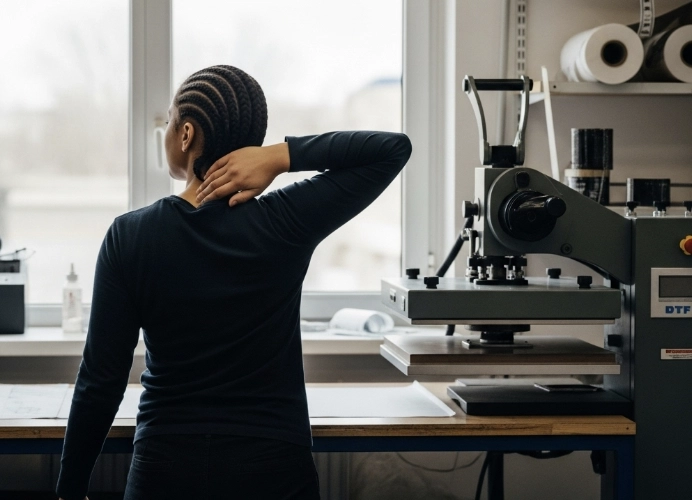
These factors require a perfect synergy of mind, eye, and body. Standing in the same position for long periods, focusing intensely on fine details, and maintaining concentration to control pressure and alignment, all drain the physical and mental energy of the screen printer.
As fatigue sets in, the accuracy of work diminishes, affecting screen printing in various ways.
Physical Fatigue:
- Shaky hands and weakened muscles: Overexerting the arm and hand muscles makes it harder to control pressure, causing involuntary shaking and uneven ink application.
- Back and neck pain: Standing in the same position and repeating the same activities can lead to muscle strain and pain.
Eye Strain:
- Blurred vision: Prolonged focus on fine lines and small marks can cause vision to blur, making it harder to see details clearly. Quality checks or stencil alignment may become more prone to errors.
Mental Fatigue:
- Reduced focus: A tired mind can easily become distracted, leading to missed steps or poor decision-making.
- Slower decision-making: Solving immediate issues, such as ink thickening or stencil clogging, becomes slower and less effective.
- Lower tolerance: Frustration from fatigue can cause screen printers to overlook minor errors that should be corrected, ultimately leading to poor quality work.
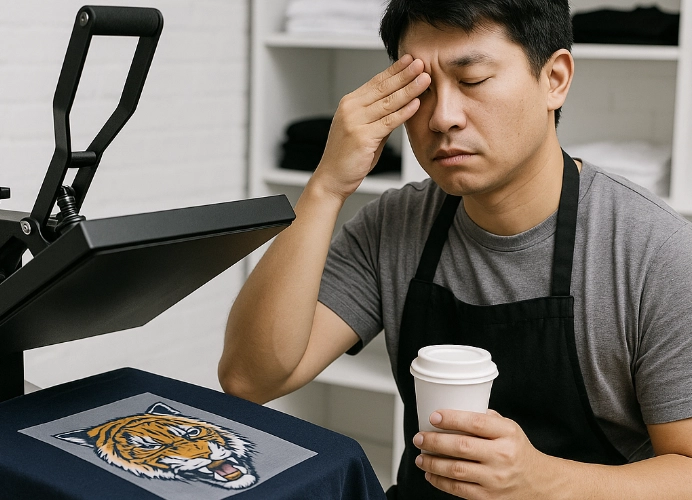
The Art of Rest: Why “Stopping” Can Help You “Go Further”
Taking breaks is not a waste of time but an investment for better results. Proper breaks can remarkably rejuvenate both the body and mind.
How do good breaks help reduce errors?
Reduce fatigue and office syndrome
Standing and operating a printer or controlling a machine for hours on end often leads to muscle fatigue, particularly in the shoulders, back, and wrists. Short breaks help relax muscles and reduce the risk of long-term cumulative injuries, improving overall health.
Restore focus and decision-making
A tired mind often leads to poor decision-making, such as selecting the wrong pressure or forgetting to check the printer temperature. A 5-10 minute break helps the mind refresh and make more accurate decisions. The human brain cannot maintain focus on a single task for extended periods; short breaks are like a “restart” for the nervous system, allowing the mind to clear and focus better on the details of the work when returning to it.
Reduce printing errors
Frequent printing errors often result from a “loss of focus” by the operator, even for a brief moment, leading to increased costs. Good breaks are a worthwhile investment, such as in DTF screen printing systems where adhesive, film, and ink can be wasted.

Prevent repetitive strain injuries (RSI): Screen printing work carries a risk of repetitive strain injuries (RSI) in the wrists, arms, and shoulders. Getting up and stretching during breaks helps relieve muscle tension and reduces these risks, allowing muscles to rest.
Increase problem-solving efficiency: Ever had a moment where you couldn’t figure out a problem, but after getting up to make coffee, you suddenly had an idea? Changing posture and environment for a short time allows the brain to process information in “background mode,” often leading to solutions or new ideas in work.
Effective Break Techniques for Screen Printers
A good break doesn’t necessarily have to be long, but it should be of high quality to ensure efficiency without disrupting work too much:
Adapted Pomodoro Technique: Set a continuous work period of 45-50 minutes, followed by a 5-10 minute break. During the break, stand up from your screen printing table, walk around to get a drink of water, stretch, or look out the window to rest your eyes.
Micro-breaks: Use 30-60 seconds during the time when waiting for ink to dry or after finishing a print run to close your eyes, take deep breaths, or twist your body to relieve tension.
Change Activities: Instead of taking a break by using your phone, which still strains your eyes, try activities that don’t require intense focus, such as listening to light music or chatting with coworkers.
Quality Lunch Break: Use your lunch break fully and try to eat away from your workspace to change the environment and truly rest your mind.
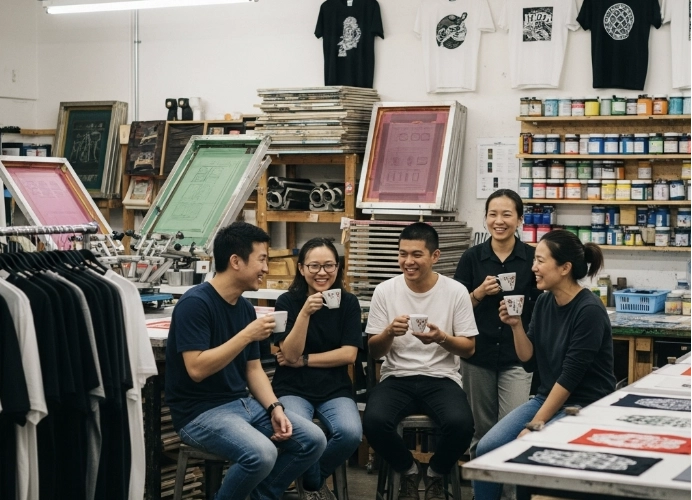
Long breaks are also important. Take a 15-20 minute break every 4 hours. During these breaks, try to distance yourself from the noise of printers or screen light to allow your mind to reset.
Conclusion: Screen printers who take breaks are the best
Ultimately, the quality of screen printing is not measured by the number of hours spent at the printing station, but by the final result on the finished product. A screen printing shop that understands and prioritizes breaks for its team is investing in its most valuable asset: “people.”
Breaks are not a symbol of weakness or laziness; rather, they acknowledge the physical and mental limitations of human beings. In the end, a single well-printed shirt is more valuable than ten shirts filled with flaws from overworked printers.
So, the next time you see a sharp, vibrant, and perfect screen print, remember that behind that success may lie a powerful period of “rest.”
High-quality screen printing shops today are not just measured by their speed in delivering work, but also by their attention to the working system, from printing machines to quality control, and “the well-being of the screen printers.”
Systematic break times are not just for the health of the screen printers but also reflect the shop’s commitment to ensuring that every print is sharp and meets the highest standards.
Ready to Print Custom DTF with Screen168 Bangkok?
Single pieces to bulk wholesale. Free artwork file check and instant online pricing 24/7.
🚀 View Sizes, Prices & Order Online→