
Common DTF Garment Printing Questions at Screen168
Common DTF T-Shirt Printing Questions and Answers

Q: How long should the heat press time be for each fabric type?
A: For cotton fabric, use high heat around 160–175°C for about 10–15 seconds.
For polyester fabric, reduce the heat to 140–150°C and press for a shorter duration.
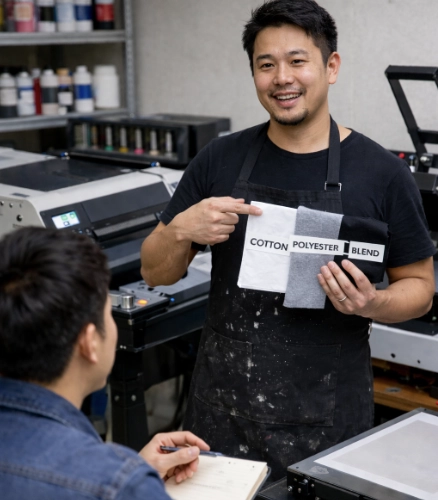
For blended fabrics (Cotton/Poly Blend), set the heat to a medium level, not as high as pure cotton, and not as low as pure polyester. The pressing time should be long enough for the adhesive to fully penetrate the fabric layers. Since the fiber blend ratio varies by brand, it’s best to test a small sample before production.
For stretchy fabrics like spandex or nylon, use low heat and short pressing times with minimal pressure to avoid fabric distortion or shine. Allow the film to cool completely before peeling.
For thick fabrics like canvas, linen, or coarse materials, use medium to high heat and a slightly longer pressing time with consistent pressure. Post-pressing after peeling the film helps smooth the surface and increase durability.
For non-woven materials or heat-sensitive materials, use very low heat and short pressing times. If re-pressing is necessary, do so briefly with a Teflon sheet or cotton cloth in between.
The key is not to rely on a single number but to follow the principle: fabrics that can withstand higher heat can use higher heat and longer times, while heat-sensitive fabrics require lower heat and shorter times. Always test on actual fabric and film samples.
Q: What should be done for quality control (QC) checks before sending garments to customers?
A: Post-press QC checks should be performed on every item.
Having a consistent QC checklist can reduce claims and rework.
Check the edges of the print on all sides by gently lifting with your fingers. There should be no lifting. If there is lifting, re-press briefly with appropriate pressure.
Check the smoothness of the surface for bubbles, lines, or adhesive residue. If present, use post-press with parchment paper or Teflon for one round.
Test the stretch and recovery of the fabric, especially on stretchy materials. The print should not crack or wrinkle.
Test the washability of the print according to the recommended washing instructions. If the print cracks easily, adjust the pressing parameters and re-test.
Document and maintain a systematic QC process to ensure prints are secure, vibrant, and durable.
Q: How do humidity and temperature affect DTF printing?
A: In hot and humid climates like Thailand, be cautious of environmental impacts.
High humidity can cause fabrics to retain more moisture, requiring longer pre-press times and storing film and adhesive powder in sealed containers with silica gel.
High room temperature can cause heat presses to overheat, leading to significant discrepancies between displayed and actual temperatures.
Direct air conditioning or fans blowing on the pressing area can cause the press area to cool abnormally, especially for cold peel jobs.
Establish press room regulations, such as avoiding direct air conditioning on the press, setting up tables away from windows to avoid direct sunlight, and calibrating temperatures regularly.
Q: What are common mistakes and how to avoid them?
A: Relying solely on the machine display without using an infrared thermometer can lead to temperature discrepancies.
Neglecting pre-pressing, especially for thick fabrics or those stored in humid conditions, can result in uneven adhesive melting.
Uneven pressure across the press plate due to worn-out pads or machine tilt can cause print edges to lift or peel.
Incorrect timing when peeling the film, such as using hot peel on cold film or vice versa, can cause misalignment or wrinkling.
Using a fixed temperature and time for all fabric types without considering thickness and heat absorption can lead to inconsistent results.
Q: Why do print edges lift after peeling the film?
A: This is usually due to insufficient heat, time, or pressure, or incorrect timing when peeling the film. Adjust by increasing the pressing time slightly, ensuring even pressure, and using post-pressing briefly to fix lifted edges.
Q: Is pre-pressing necessary every time?
A: Highly recommended, especially for thick fabrics, fabrics stored in humid conditions, or new fabrics that haven’t been heat-treated. Pre-pressing helps remove moisture and smooth the surface.
Q: Why does the print appear dull after pressing?
A: This could be due to excessive heat or pressing time, or uneven heat distribution. Reduce the heat slightly and test multiple settings around the optimal range. Check the press plate and pad surface for any irregularities.
Q: If the print cracks easily after washing, does this mean the adhesive is poor quality?
A: Not necessarily. The issue could be due to improper pressing settings or overly aggressive washing. Test washing with different settings and provide clear care instructions to customers.
Setting heat and time for DTF printing is not just about memorizing numbers but about understanding fabric characteristics and adjusting variables accordingly. Each fabric type—cotton, polyester, blends, spandex/nylon, canvas/linen, or non-woven—requires a unique balance of heat, time, and pressure. Proper pre-pressing and post-pressing techniques, timing film peeling, maintaining consistent heat, and systematic QC documentation are key factors in achieving secure, vibrant, and wash-resistant prints while reducing hidden production costs.
Ready to Print Custom DTF with Screen168 Bangkok?
Single pieces to bulk wholesale. Free artwork file check and instant online pricing 24/7.
🚀 View Sizes, Prices & Order Online→