
Insight into DTF Garment Printing Techniques: How to Tell if the Adhesive is Just Right?
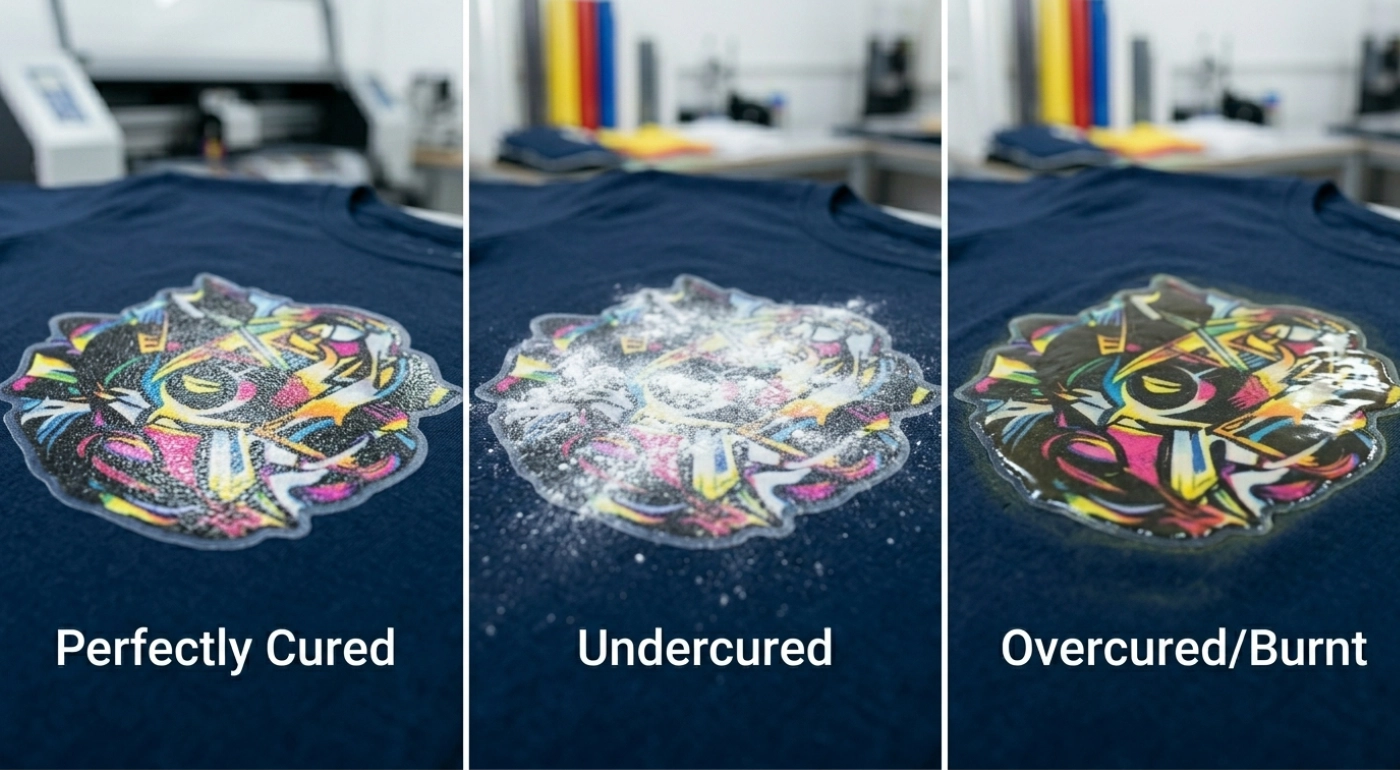
Mastering DTF T-Shirt Printing: The Crucial Step of Adhesive Curing
In the process of running a DTF (Direct to Film) T-shirt printing shop, many people focus primarily on the clarity of the printer and the quality of the ink. However, the true heart of the matter that determines whether the printed garment will last or peel off after a few washes is the adhesive curing process. This article will delve into professional techniques to help you identify whether the adhesive you are curing is “perfectly cured,” “under-cured,” or “over-cured,” thereby elevating your printing standards to perfection.
Why is Perfectly Curing DTF Adhesive So Important?
DTF Hot Melt Powder (Polyurethane Hot Melt Powder) changes state when heated, from fine white powder to a clear gel-like substance, and when pressed onto fabric, it bonds firmly with the fibers.
If the adhesive is perfectly cured: The print will be highly flexible, well integrated into the fabric, vibrant in color, and durable against washing or stretching.
If the process is mishandled: The print may crack, peel off, fade, or make the fabric feel stiff.
3 Signs That DTF Adhesive is Perfectly Cured
Evaluating whether the adhesive is cured properly relies mainly on visual inspection. Here are the characteristics of perfectly cured adhesive:
- Orange Peel Texture
This is the most noticeable sign. When the adhesive is perfectly cured, the white powder will completely melt and form a clear film over the ink. However, the surface will not be smooth like glass but will have a slight texture resembling the skin of an orange. This indicates that the adhesive has melted and bonded sufficiently, retaining its structure to expand when pressed in the final step.
- Semi-Glossy Finish
When viewed under light, perfectly cured adhesive will have a semi-glossy finish, neither overly shiny nor dull. The color of the ink underneath will shine through clearly.
- No Remaining White Powder
Inspect the edges of the print or gradient areas. There should be no white powder residue visible. Every particle of the adhesive must have melted and bonded seamlessly.
How to Identify Under-Cured Adhesive
Under-curing occurs when the curing temperature is too low or the curing time is too short (especially for thick white ink prints or in humid conditions).
Characteristics:
The surface of the adhesive will look cloudy and opaque.
When reflected in light, white particles resembling sugar granules or sand will be visible on the print.
If you gently rub the surface (after it has cooled), it will feel rough and may leave adhesive residue on your finger.
Impact: When pressed onto fabric, the adhesive will not bond properly with the fibers, causing the print to peel off during washing or when removing the PET film.
How to Identify Over-Cured Adhesive
Sometimes, screen printers worry that the adhesive is not fully cured, so they increase the heat and time excessively, which can be as detrimental as under-curing.
Characteristics:
The surface of the adhesive will be flat and smooth, lacking the orange peel texture.
It will have a glossy, oily appearance.
If left too long, the clear adhesive may start to yellow or brown.
Impact: Over-cured adhesive loses its flexibility. When pressed onto fabric, the print will feel hard and brittle, like thick plastic, and may crack easily when the customer wears or stretches the garment.
Factors Affecting Curing Time
There is no fixed formula for curing time as several variables must be considered:
Curing equipment: Using a conveyor oven provides consistent heat and better temperature control compared to a heat press.

Room temperature and humidity: On rainy or very cold days, the adhesive may retain moisture, requiring longer curing times to remove it.
Thickness of adhesive and ink: Thicker white ink and more adhesive require longer curing times to ensure heat penetration to the deepest layer.
Recommended temperature: For standard curing ovens, temperatures are typically set between 130-150°C, with a curing time of about 2-3 minutes (adjust according to your specific materials).
Achieving Reliable Printing Standards
Controlling the quality of adhesive curing is an art that requires attention and experience. For screen printing shops, releasing under-cured or over-cured work to customers can severely damage brand credibility.
We understand the importance of every step in the DTF printing process. We strictly control temperature and environmental conditions to ensure that every particle of adhesive on the film melts at the perfect curing point.
If you want vibrant, flexible prints, choosing a partner or manufacturer who deeply understands the “perfect curing” of DTF adhesive is the best choice for your favorite garments.
Ready to Print Custom DTF with Screen168 Bangkok?
Single pieces to bulk wholesale. Free artwork file check and instant online pricing 24/7.
🚀 View Sizes, Prices & Order Online→