DTF Roll-to-Roll vs Sheet Printing: Which Is More Cost-Effective for Custom T-Shirt Printers?

📑 Table of Contents (Quick Jump)
The custom t-shirt printing industry has been completely revolutionized by Direct-to-Film (DTF) technology. Today, apparel printing entrepreneurs face a crucial investment decision when outfitting their workshops: choosing between a roll-to-roll DTF printing system or using pre-cut DTF transfer sheets. Selecting the right system based on your production scale and operating budget directly impacts your net profit, hidden overhead expenses, and turnaround times for clients. This article provides an in-depth analysis of cost-efficiency, per-unit expenses, and ideal application scenarios for both systems to help custom t-shirt printers make precise and profitable investment decisions.
Understanding Both DTF Shirt Printing Systems
Before comparing financial viability, we must understand the fundamental workflow of each system. A roll-to-roll DTF printing system is an automated production line that feeds continuous rolls of film through the printer, applies adhesive powder, and heat-cures the material in a single continuous process. This setup is ideal for businesses handling high-volume, continuous orders. In contrast, DTF sheet printing involves feeding pre-cut film sheets—such as A3 or A4 sizes—into the printer one at a time, followed by manual or small-scale powder application. This method suits small print shops and industry beginners.
Analyzing Costs and Production Efficiency of Roll-to-Roll DTF Printing
Investing in a roll-to-roll DTF printing system offers a clear advantage in raw material costs per square meter. Rolls of film and bulk adhesive powder are significantly cheaper when purchased in large quantities, and the automated powder shaking process minimizes adhesive waste. Furthermore, this system drastically reduces labor time because the printer can run autonomously for hours without requiring an operator to feed individual sheets. However, the primary drawback is the substantial initial capital investment required for industrial roll printers, large curing ovens, and a dedicated ventilation room to manage exhaust and humidity.
Analyzing Costs and Flexibility of DTF Sheet Printing
Conversely, using DTF transfer sheets caters to apparel printers who are just starting out or operating in limited workspaces. The initial equipment cost is remarkably low because it relies on compact desktop printers that are easy to maintain, eliminating the need for complex automated powder shaker units. Business owners can scale production precisely to match actual order quantities without wasting film due to unused idle rolls. The unavoidable downside, however, is that raw material costs per sheet are nearly double those of roll stock. It also demands intensive manual labor to feed sheets and apply powder individually, capping daily output based on available manpower.
Time Factors and Labor Costs in Real-World Operations
Comparing cost-effectiveness extends far beyond raw material prices per sheet or meter; it requires factoring in labor hours and payroll expenses. Most t-shirt printing orders come with tight delivery deadlines. Fulfilling orders in the hundreds using DTF sheets quickly fatigues operators, increasing the risk of printing errors and wasted materials. Meanwhile, a roll-to-roll system requires only a single attendant to monitor production, generating thousands of prints rapidly and driving labor costs per garment down significantly when compared against equivalent output volumes.

Workspace and Environmental Requirements for Equipment Installation
Shop location is another decisive factor in overall profitability. Roll-to-roll DTF systems demand substantial linear space for conveyor curing ovens and heat exhaust ducting. For shops located in tight commercial shophouses or urban spaces, installing a roll system can create challenges with ambient heat and chemical odors. On the other hand, DTF sheet printing requires only a single workstation table alongside a standard heat press to begin accepting t-shirt orders immediately, making it the preferred choice for home-based printers and compact studio spaces.
Calculating Hidden Overhead and Printer Maintenance Expenses
When evaluating investments in DTF printing equipment, many buyers focus solely on machine tags and per-square-meter consumable prices. In-depth analysis reveals that hidden overhead costs ultimately determine shop profitability. Roll-to-roll printing systems often incur higher printhead maintenance expenses if left idle, as ink sedimentation and nozzle clogs occur easily without daily flushing cycles. Operators must account for cleaning solutions, annual servicing contracts, and continuous electrical draws from heavy heating and air-filtration units.
Conversely, sheet-fed DTF systems offer greater operational flexibility regarding power management. If no orders arrive on a given day, operators can shut down the equipment instantly without worrying about ink settling in large circulation loops. Nonetheless, manual labor expenses for monitoring and inspecting every single sheet remain noticeably higher. When factoring in hourly minimum wages, small-batch runs favor sheet printing, but as order volumes scale upward, labor overhead quickly surpasses the operating expenses of automated machinery.
Managing Material Inventory and Workshop Storage Space
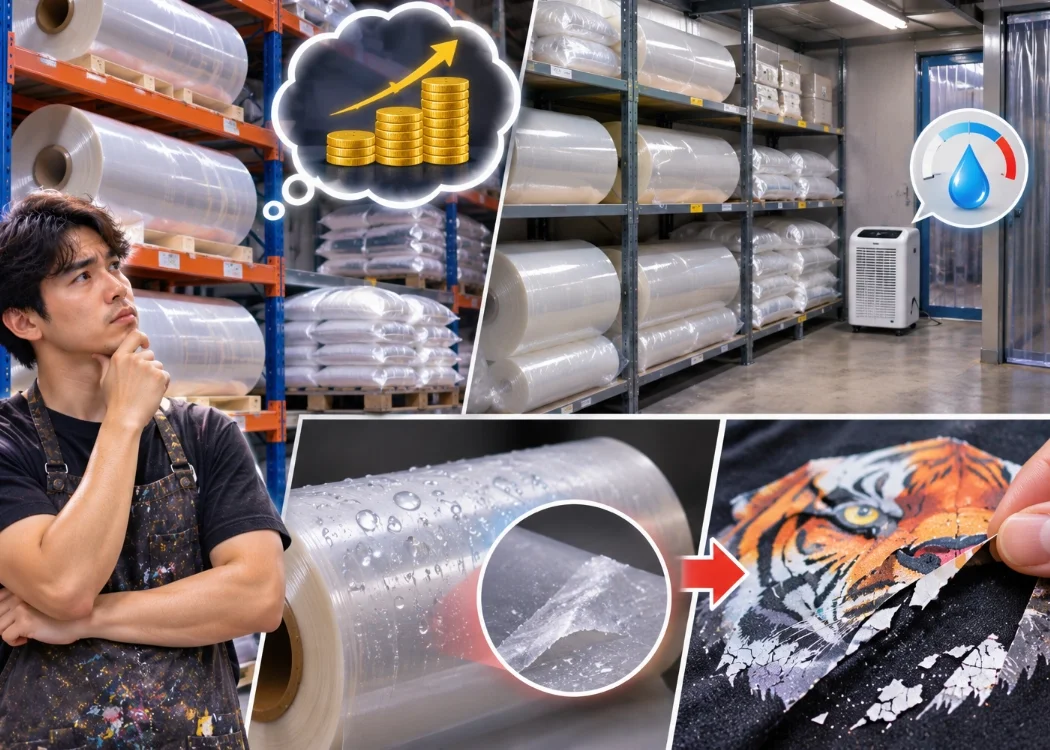
Raw material storage is another direct driver of operational expenses. Purchasing DTF film and adhesive powder in bulk rolls secures lower wholesale pricing per unit, but requires heavy-duty storage space and strict humidity controls to prevent film degradation. Improper storage allows atmospheric moisture to damage the film emulsion layer, resulting in peeled transfers and catastrophic material waste.
For shops with spatial constraints, pre-cut DTF sheets provide an effective storage solution. Because the film arrives pre-sized, boxes can be neatly stacked in small corners without requiring large vertical spindles or bulky roll racks. Business owners maintain simpler inventory control without tying up massive working capital in raw supplies, suiting entrepreneurs launching with limited cash flow and requiring high liquidity.
Handling Rush Orders and Design Flexibility
Market demands for custom apparel frequently involve urgent deadlines, on-site adjustments, or orders featuring diverse graphics changing daily. DTF sheet printing delivers maximum flexibility for inserting urgent print jobs because operators can instantly swap digital files and print custom-sized sheets without waiting to fill a full roll or worrying about optimizing layout space on continuous film.
In contrast, roll-to-roll DTF systems are engineered for continuous batch manufacturing. When clients order hundreds of shirts featuring a single graphic, roll systems execute the job rapidly at the lowest unit cost. However, splicing rolls to print small quantities of disparate designs generates excessive film waste and wastes valuable time resetting page layouts, reducing automated efficiency. Custom t-shirt printers must evaluate their core customer base to determine whether they specialize in diverse retail runs or large-scale wholesale batch production.
Summary Recommendations for Custom T-Shirt Printers
Choosing between these two systems depends entirely on your physical workspace and average order volume. If your print shop consistently receives over one hundred t-shirt orders daily, investing in a roll-to-roll DTF printing system achieves faster ROI and superior long-term profitability due to lower unit costs and reduced labor requirements. However, if you are launching a startup, handling low-volume batches, or focusing on diverse, non-repeating rush orders, utilizing DTF film sheets offers superior operational flexibility and significantly lower financial risk.
If you are planning to make team shirts, launch an apparel brand, or take on client orders and want to check your design proportions before production, you can access Screen168 Studio for free with no watermark.
Ready to Print Custom DTF with Screen168 Bangkok?
Single pieces to bulk wholesale. Free artwork file check and instant online pricing 24/7.
🚀 View Sizes, Prices & Order Online→